Showing posts with label Bust the Stash. Show all posts

Friday, May 26, 2017

Knitting Through The Stash

I’ve been doing a lot of knitting lately but, somehow, my output is down. I can’t explain it. Between January and May 2016, the year of workaholism, I knitted 17 projects. Between this January and May I’ve knitted 8 - and there's currently one project on needles. Am I making more complicated projects this year? Not really. Sure, February was a bit of a wash, with the move, and I have knit some yarn-intensive scarves this year (as opposed to smaller accessories). But I find it hard to believe that these two factors have lead to a 50% decline in productivity in 2017. I do love Ravelry because it gives me endless useful data (and it allows me to contribute to a data stream that will inform other knitters for years to come). And it keeps me honest. I suppose I could compare yarn weights and yardages of individual projects to confirm that my assessment of down-output is correct. One thing's for sure - I'm not knitting any less frequently. Note: I suspect my willingness to plan in ever more detail and to rip back work I'm not loving may be leading to longer spans knitting one item...

Of course, it doesn't matter. Well, I say it doesn't matter but I knit presents, for the most part, all year long and I never have an issue finding good homes for the finished objects. To some extent, knitting is my gift stash - my boutique of hand mades (which do not look home made!). On the one hand, I knit often (and quickly) because that's how I roll. On the other hand, I get to knit all kinds of strange things I might never have come to organically because I'm committed to using my stash yarn (even if I do replace it more frequently than necessary). That combo leads me down a very productive path, for the most part.

My urge to destash (well, not so much to destash as to use the yarn I've purchased because I desired it it and I wanted to use it) has resulted in finished objects that , in retrospect, I'm very happy to have constructed, even if I wouldn't have chosen them under different circumstances (which is to say if I'd had larger yardages of remainder yarn).

That's how these things came to be:

The Vertex vest was a crap shoot - a strange, asymmetric vest that could be very chic or super granola. The yarn, bought in a moment of nostalgia last year, was also a crap shoot. It has great hand but it's an awkward colour, especially in a land so perennially taupe. It took forever to match it to a garment. I aimed to use as much as possible of the 1500 yards I purchased, because it's been strangely difficult to purpose. It's very silky with a ton of drape. It would make a great (if stretch-prone) blanket but I didn't have enough of it to go that route. The colour isn't flattering enough to wear against my skin without something to break up the beige. Vertex uses a lot of yarn for a vest, though less than the pattern suggests, but that's partly because I changed the dimensions - particularly vertically. I didn't want to go too long given that I'm short in the torso - and given the propensity of bamboo to stretch. (Note: the alpaca gives it a kind of resiliency, along with the chainette construction of the yarn, to mitigate over-stretch.)
Vertex Vest
I thought I'd give it away as a big-ticket gift (my mother knows what that means) but I couldn't do it. There's something so warm and comfortable and, strangely, even chic about this vest. It's not perfect but I could see myself making it one more time in a slightly sturdier fabric in a better colour.

What will I do with the remaining yarn? Probably, I'll make another Starshower. Having made it before, I know that I can use up all of the remaining yardage.

Lessons Learned: Don't buy taupe. Experiment with different fibers - it makes things challenging and interesting. Try a pattern out of the comfort-zone - but with touchpoints that are likely to make it work.

This Stockholm scarf, which I made in the round, is an interesting exercise in simple lace-work but I don't love knitting lace. Occasionally I do it because, damn, it looks pretty and when the pattern, yarn and yardage align, you have to adventure. This used every last inch of yarn I had - only the second time I've experienced this in all of my time knitting. It's wash/dryable, very feisty and soft. I've lost interest in cerise, of late, but I know this will be a popular gift:

Stockholm Scarf

No remaining yarn. I first used this yarn to make this sweater - but I never wore it (who needs a short sleeved sweater??).

Lessons Learned: Do smaller lacework projects to keep the process from becoming tedious. Don't work with the Filatura unless size doesn't really matter. This yarn stretches stupidly, the way so many superwash yarns do. That's why I'll no longer knit superwash unless the project is socks, something for a baby or something unfitted that gets a lot of wear. Because I won't hand wash and dry those sorts of things.

Then there's the two- (or more-) toned simple sock thing I've got going on. I've become comfortable with colourwork by using up random yarns together to make pairs of socks out of small remnants.


What will I do with the remaining yarn? Well, in the end, there's very little left (though enough to fix holes). The best part is figuring out how to use the complementary yarns in different ways so that you get more pairs of socks by inverting the pattern from pair to pair.

Lessons Learned: You can really use up every last yard of yarn if you're willing to get granular enough. Only 3g of yarn are needed for a toe. So get creative with socks - colour-wise if not pattern-wise. (But don't mix colour and patterns. They cancel each other out.)

The Binary Scarf gave me the opportunity to do a fancy-seeming Brooklyn Tweed pattern without using the yarn (which is a pain in the ass to knit with and scratchy against the face). But it's made in a BT-style neutral, albeit using Quince Finch:

Binary Scarf
I used unwound, not rewashed yarn in a colourway I never liked on myself (taupe with a pink undertone?!) Originally it formed the bulk of this sweater. I never wore that thing. So unknit it was. I do wish I'd started with washed yarn, so I could have seen how open the initial end result was destined to be. I'd have gone down a needle size. In the end, I shrank it a bit in the dryer to bring the pattern to the fore. Quince shrinks a lot, and quickly, but it doesn't seem to felt.

What will I do with the yarn left over? I still have 230 yards left over... I have no idea what I'll do with it. A matching hat, perhaps? I'm so not into knitting hats...

Lessons Learned: Don't make a patterned scarf with unwound, kinky yarn. It takes the fun out when you can't see the pattern emerge. And flat scarves are freakin' boring to make, no matter the pattern, unless there's colour work involved.

What I'm knitting now:


Welcome Back Garter
I am knitting this one on a whim. And I'm not whimsical. There's a 3 skein version and a 6 skein version. Perfect way to use up a 400 yard skein and 5, 130 yard batches of fingering yarn - or 3 single skeins of 400 yards each. It produces a bias-cut shawl in garter stitch. Super fast, uncomplicated knitting on US 6 needles. And the colour possibilities are endless. I can totally see myself doing the 6 skein version when I've got moderate increments of yarn remaining from sock projects. But in this instance, I'm using 2 colourways I bought at the Yarn Frolic (Shelridge Yarns in Pussywillow and Sweet Georgia Tough Love Sock in Mink) and a third colour (Sweet Georgia Tough Love Sock in Slate) that I've already used some of to make a pair of socks, given that I bought 2 skeins.

If you're into colourwork, this is a fantastic, fun knit. If you're into buying single skeins of sock-weight yarn and they orphan cuz you never make socks, but you haven't got enough of the yarn to make much more than socks, this is a great pattern. The emerging mosaic is so enjoyable. I'm using merino with nylon so that I'll be able to throw this shawl in the washer and dryer.

If you want to destash, getting comfortable with colourwork is a worthy undertaking. I'm partial to stripes and colour blocking. I haven't had the chance to do to much in the way of intarsia or stranded yet. But I'm not afraid of these techniques and, sooner rather than later, I'm going to get bold and steek.

So that's a bit of a knitting update.

Today's questions: Do you obsess over your stash or do you eat through it with little concern for what may become of the remanants (or the full yardage, if it's a challenging fiber)? Have you got a recurring colourway in your stash that you never seem to use because you really don't love it, though it beckons in the store? Is your knitting 20 per cent for you and 80 per cent for your gift boutique? Let's talk

Tuesday, April 5, 2016

Bust the Stash: Finished Object 13 - Cutter Sweater (Custom Fit) and an Update on Bust the Stash

So it's minus 10 C again and I'm back to wearing fur. At least, today, it didn't snow/slush. And there's sun. But, man, when I consider how most people living in most places have better winter weather than we have in spring, well, it rankles. Fortunately, I haven't had much time to dwell on it. Work continues to challenge me. As previously mentioned, when I'm stressed, the methodical rhythm of knitting is meditative. (I actually meditate, btw, so I can confirm, anecdotally at least, that the activity works on the mind-body just like other forms of stillness and movement meditation.) It appears that the more stressed I am, the faster I knit. 

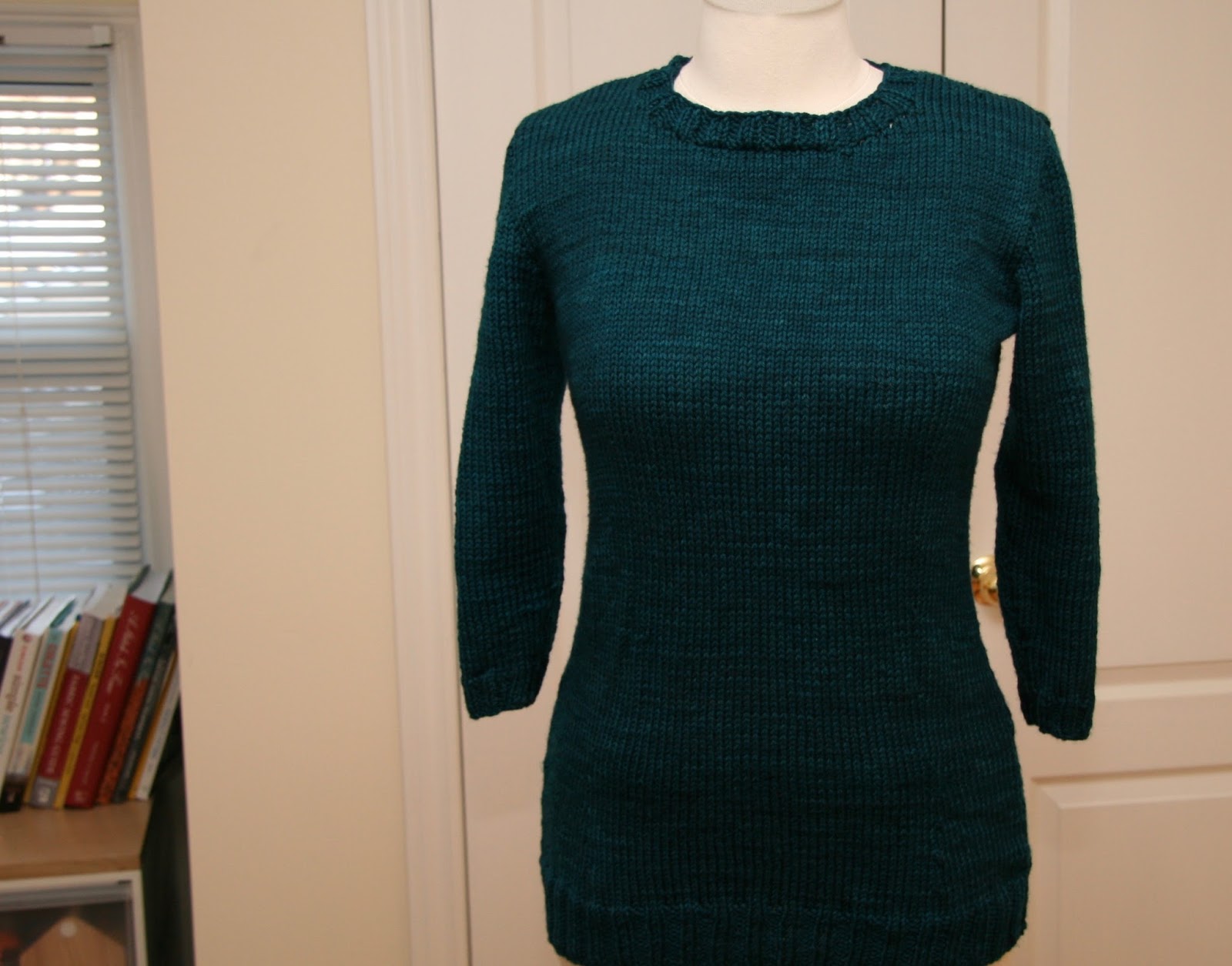
To wit: I finished a sweater in 9 days:  


Requisite disclaimer: The dress form is wider than me but this sweater is pretty stretchy.
It would not take a good picture, sadly. The light was bad this morning. This sweater, the Cutter, is longer than I would have liked by about an inch or inch and a half. On me, this falls firmly over the derriere and is practically tunic length. That's mainly because I used super wash yarn and it over-stretches when blocked (see freak out below). I also didn't get gauge (though I made a robust swatch and blocked it). As I made it, I had to renegotiate row gauge to get to the requisite length. Somehow I did a lot of paying attention but I didn't actually look at the length to ensure that I liked it.

Elegant, if simple, waist-shaping...
This is my second Custom Fit effort and it's designed by Amy Herzog, the Custom Fit founder. It's exactly the same (except for the rib pattern used on hems and neckline) as my other Custom Fit sweater - Kristin's Basic Pullover, formerly known as Kristin's Basic Cowl, which was legitimately my "invention" - albeit a very plain one. 

Here's what I'll say about Custom Fit this time around:
  • The pattern wasn't perfect. I encountered missing headings that would likely confuse a newish knitter.
  • This system excels at determining shoulder-width and vertical dimensions.
  • Amy's Fit to Flatter premise is somewhat different than mine. Hers is, dare I say, somewhat more suburban than mine. This time around, having learned from the relative looseness of the KPB, I actually altered the recommended dimensions even more substantively than I did last time.
Brief explanation of Custom Fit: 
  • You take a zillion vertical and horizontal measurements and input them into the CF system. 

  • Then you swatch to get the texture of fabric you desire. Then you apply the swatch to the sweater pattern you want to knit (either an Amy Herzog pattern, presuming that it's already in the system, not all of them have been uploaded yet - OR a design of your own based on available parameters). 
  • Mathy magic ensues and you get a chance, before the pattern is actually created, to go rogue with the proposed measurements. Last time I was conservative. I knew that I didn't want positive ease in the waist and that the hips would likely be too large, but I figured that, with all of my actual measurements provided - and having indicated my desire for CLOSE fit - that I would indeed get a pattern to reflect this. Instead the horizontal measurements were all a bit too big (with the exception of shoulder width). 
  • Then you click "ok" and you get a recipe or a pattern fitted to you. Note: the difference between recipes and patterns still eludes me so I can't really explain that part.
This time around, I entered my horizontal waist, bust and hip measurements incorrectly ON PURPOSE because I figured it would be the easiest way to get the degree of negative ease I desired. The finished garment is still a bit too big as far as I'm concerned. And I'm by no means in a slender phase. Note: This time, I attribute the size issue to my super wash yarn which, btw, I will never use again for anything other than socks and baby garments. Drape plus messed-with yarn fibers (to allow for machine wash and dry) produce an end result that's way bigger than whatever you can predict, even with a reasonable sized swatch. Yeah, it does shrink back as it dries but never quite as much as it should, particularly vertically. I'm going to have to put the air-dry, just-blocked sweater in the dryer to see if I can shrink it a bit more.

Here's my point. I've used CF twice now and I've had issues with size both times. 

I've also had issues with the patterns.

Last time I decided to knit using the CF "mostly seamless" instructions and ended up having to write out the detailed instructions for myself as they aren't overlaid on the main recipe. Basically, I had to mix and match, which means I had to create one doc containing all of the info (obliquely referred to in a tiny paragraph at the end of the pattern). That irritated me. This time I decided to follow the instructions exactly. I knitted flat and seamed and, man, gotta say I don't buy it. I've knitted sweaters in numerous fashions and it's a rare, plain pullover that needs side and sleeve seams for structure over and above what a seamless knit will provide. But it sure does add hours to the project.

First you have to block your pieces flat. That's a stress-fest when you're using grow-y superwash yarn (and you see your fit expectations vanish before your eyes). After 2 days, with no finished garment to speak of, you have to mattress seam the shoulders, the sleeve inset, the sleeve seam and the side seams. Yeah, I know you can seam other ways that are faster but they all look comparatively shoddy. Mattress seaming makes your seamed garment look seamless. Alas, it takes 3 hours to pull it off well.

I am much happier to block a seamless, finished garment such that, when all is said and done, and it's dry, I put it on and walk away. The last time I had a sweater to seam up it took me 3 years and it's still not done. Update: I've finally started putting this (relatively complicated cardigan) together, believe it or not. As I was waiting for the Cutter to block, I figured I had no excuse. I mean, if I'm willing to sew up one thing, why not another?

Even though I appear to be bitching about everything from instructions to sizing to yarn choice, it's likely that I'll get a decent amount of wear out of this finished garment because:
  • The colour and stitch definition are beautiful
  • It's clean and simple and it fits pretty well (if not perfectly)
  • It's warm but not stupidly so
  • Imperfect fit notwithstanding, it still fits better than my first Custom Fit pullover, so I'm counting this as progress.
Will I make another Custom Fit sweater? Probably. I see the potential in this system but I don't think it's through the growing-pains stage as yet. Will I make another one soon? Unlikely. I can actually sort out the math, for a simple sweater, fairly easily at this point and Amy Herzog sweater patterns (the only ones available using this system, other than those you make up for yourself) don't generally call to me. She designs exceedingly well and she has style, it's just not mine.

Point is, I can make a simple sweater more effortlessly when I do the thinking as part of the prep process than I can when I'm wondering about what might go wrong if I'm not controlling the full picture - especially given the outcomes I've experienced with CF to date. And when it comes to the complicated sweaters - those I might want to leave in the hands of a computer generated pattern - I'm not really motivated by the offerings available.

It just goes to show that a weird vest made on a stash-busting whim can turn into the most excellent finished object while, by contrast, a carefully prepared, custom designed item can be sort of dull on completion.

On another note, and not to bury the lede, I'm done with this phase of Bust the Stash. 

All I've got left to make is a bunch of hats and half-mitts which do not excite me at this time. Having said this, every yard of my remnant stash yarn is allocated to an upcoming project so the minute I opt to get back to it, I'll have Xmas projects ready to go. 

I've used up @6200 yards of yarn since December, 2015 (some of which I bought, um accidentally, after starting the stash-busting project) . 1800 yards of this was lace-weight, which you  know takes a zillion times longer to use than the same amount of worsted. My yarn box has more than enough space now to add in a few new skeins. The goal is to add these skeins intelligently - to recognize that I will have to use the remnants at the end. My stash is down to 3100 yards, in different fiber denominations of @100 yards each. I know exactly what I have to get through and I have a plan to ensure that my stash doesn't get out of hand next time I go through an acquisitive moment.

Moreover, I've learned a lot about what I like to knit:
  • Accessories
  • Unique, "odd" garments that nonetheless work in a wardrobe
  • Really well-drafted patterns
  • Garments with more spring than drape (no super wash!)
  • Really simple, eminently practical garments (that perfect simple scarf or vest)
  • Sweaters - in sport-weight yarn. Sport-weight produces the best fabric, having optimal ease and drape for size, with the least effort.
  • Simple stitch patterns. I'll take colour work any day over cables or whack stitch patterns. Mind you, working all in one colour in stockinette, garter, seed or rib can be extremely satisfying because they allow fit and fabric to shine.
So that's a lot to talk about. I'd love to hear your thoughts about my latest sweater - what do you think? How about Custom Fit? Do you like it? Have you tried it? And finally, whatcha think of my stash-busting exercise to date? Wanna try to convince me to keep on without buying new until every last yard is gone? Give it a go!

Saturday, March 26, 2016

Bust the Stash: Finished Object 12 - Circular Vest

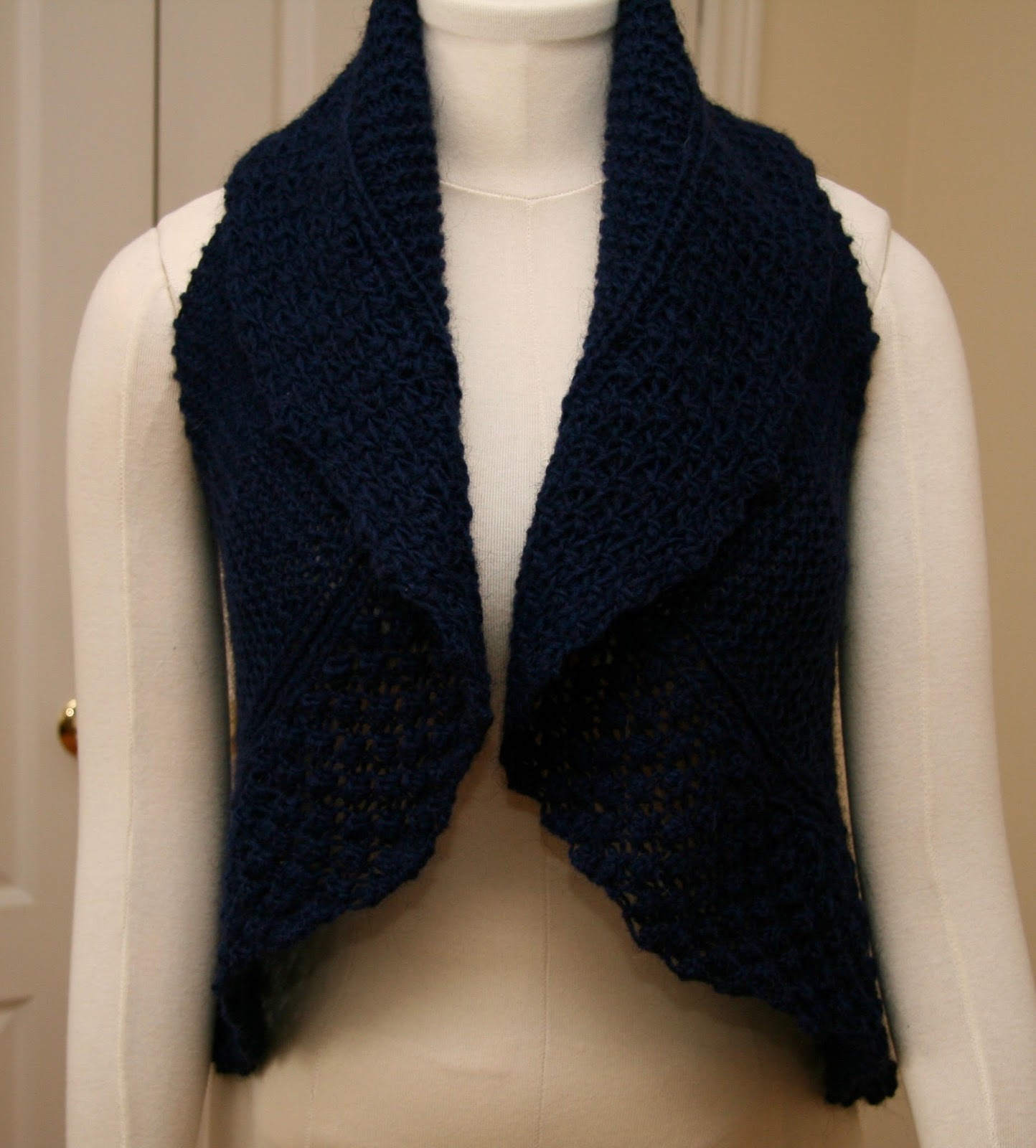
I fucking love this one:


Sometimes stash-leads to kismet. Y'all have to make this garment. It takes about 2 weeks (if you're serious) and somewhere around 500 yards of aran-weight yarn. You could easily make one for your best friend for Xmas and totally blow her mind!


Let's Talk About The Pattern: It's not a difficult knit but it is a bit fussy and it does get tedious at the end. Mind you, it's pretty enjoyable, despite that, because the fabric that emerges from one (reasonably) straight-forward pattern 4-row repeat is pretty cool. With a simple flat-knit, short row technique, the waistcoat becomes a circle which is seamed up at the end and into which a back panel is inserted. The armholes are the unsewn space between the sides of the waistcoat circle and the back panel.

Here's the thing, next time, I'd do this differently. Yeah, I know, next time I do everything differently but hear me out. Instead of seaming up the bound-off edges of the circle at the end, which can be a bit messier than necessary, I'd provisionally cast on, at the start, and 3-needle bind off the 2 edges of live stitches at the end. This would take virtually no additional effort. I'd also consider picking up stitches at the bottom of the waistcoat circle, knitting the required number of rows and then seaming it at the top. Mind you, the back panel is inserted width-wise to match the direction of the garter stitch in the waistcoat, so that consistency would be sacrificed for a neater join...


I made the back panel wider than the pattern calls for because I think, as drafted, it looks skinny and strange. I also made it shorter so that the armholes wouldn't be too long for me. What I'd say is that the instructions, from a sizing perspective, are a guideline. I made a modified medium, after starting with a small and realizing that it likely wouldn't be long enough given that I worked with needles 2 sizes smaller than recommended. Strangely, I got gauge with those needles, but gauge is worked in garter and I don't think it translated well to the very nubby blackberry pattern at the edges of the waistcoat circle. Having said that, I like the fabric that the smaller needle size produced so I would definitely use the same needle size again.

Great thing is that every size of this garment starts exactly the same way, by casting on 44 stitches. This allows for easy modification as you go. See my Ravelry notes for more details on what I did to modify the size.


What about that crazy yarn?? As you know, my friend Michael brought me back the Lett-Lopi from Iceland last summer as a gift. He bought it in the grocery store and cheerfully advised that it cost $4.20 CDN per skein. This garment took slightly over 4 skeins so, technically, this garment cost under $20 bucks to make.

BTW, Karen Templer from Fringe Association (a blog you should follow whether you like knitting or not), is a nut for this yarn. She started singing its praises recently (long after it had made its way into my stash) and that gave me confidence to try it out. Part of my issue is that I didn't really have enough to make a sweater and it's not well suited to small accessories that touch the skin.

This yarn is hardcore. It's like wearing a sheep. It's hairy and scratchy (though not as scratchy as it looks - and less scratchy still after blocking, especially if you follow up the wash with a soak in hair conditioner. BTW, don't use a lot of conditioner and don't rinse it out at the end.)

The yarn is unparalleled in its warmth given that shorter and longer wool fibres are carded together to produce a yarn that's spun with a lot of air trapped between these fibres. I mean, this is the stuff the Icelandic fishermen wear. The relatively untreated state of the yarn lends to its waterproof properties (these are somewhat stripped by washing, hence the addition of conditioner at the end. Some prefer to wash with lanolin-enriched Eucalan, but I don't have any and I didn't see how conditioner could hurt.)
 

This yarn is not my jam but I became increasingly enamoured of it as I went. It unrefinement is quite spectacular, if unappealing, like a harsh landscape. You can feel its durability. Furthermore, it's beautifully dyed to provide a very deep, but clear navy blue. It blocks fantastically, better than any springy yarn. On the flip side, it is barely spun. I mean, whole yards come out like carded fiber, simply held together by the strength of the wool, having disparate texture and gauge. Some bits are aran-weight, other bits like fingering. It's odd.

Now, it doesn't have a lot of drape, unsurprisingly, which is why I thought it would either work perfectly, or horribly, with this pattern. Remember, I didn't have a lot of choice given my yardage and the need to keep this second-layer. I thought that the structure could be good for this garment, as long as it didn't produce a stiff end-result.

As of now, I think it has worked entirely adequately - and time/wearing will tell if I think better or worse of it, in the end. Next time I make this, though, I'll use a drapier yarn (not alpaca, but a smoother worsted-spun) because it's the only way to get length in the garment without bulking up the collar.

What do I mean by that? Well, the bodice (waistcoat) is a circle. Whatever part of it allows for its vertical extension also gathers at the neckline to form the lovely shawl collar. I love a shawl collar but this one doesn't have modifiable dimensions because it is not seamed on. I'm already short with a short torso so this means this version has, arguably, too much collar for my proportions. But, I'd like a bit more length in that circle (than I got this time around) without adding to the bulk at the neck. The only way to achieve that is by using a yarn with more drag (i.e. a softer hand). It won't be as durable or as warm, but it may provide a better drape to suit my needs.


I think it's particularly chic with my wooden shawl pin.

Another plus of this pattern is that it can be made to suit a lot of shapes (though some better than others). I mean, a long or wide person will have better luck given how it's drafted, but it's totally achievable for other shapes. I sense it would be least suitable for a wide, short person who carries most of her weight in the middle but careful yarn choice might mitigate that issue.

So what do you think? Do you like this? Would you make it? Let's talk!

Wednesday, March 16, 2016

Bust The Stash: Finished Object 11 - Foolproof Cowl

I am exceedingly pleased with my finished Foolproof Cowl:


Everyone should make one!

Here's one side:


And here's the other:


For what it's worth, this is by no means my best work, technically (there are a couple of small errors which I won't point out because, really, no one's going to notice them). I had to go off road with the Inspriation instruction directions. Note: There are 2 versions of directions for this cowl - Inspiration (which is essentially a pattern that tells you what to do) and Free Spirit (which gives guidelines and assumes you'll create your own striping pattern). I didn't have enough yarn to do the full-on Inspiration version so I mixed and matched. As a result, my striping pattern is pretty whack - but I finished up a maximum amount of yarn and gain a maximum amount of cowl length.

At 400ish yards of Loft yarn, this is just long enough to wrap around the neck twice. I'd definitely use 500-600 yards on my next version. Happily, the size is adjustable to suit what yarn you've got to work with.


I'm of two minds about using woolen-spun yarn, such as Brooklyn Tweed, for this project. It produces a more rustic end result, and that result is warmer than a worsted-spun one. It's less inclined to pill, it gains structure and strength in blocking. Furthermore, Brooklyn Tweed yarn, for all of its rusticness, is still very soft (and springy, and "kinky"). But... You need a light touch to knit with this stuff - it has basically no twist and it likes to break if you're even a smidge too tight. I've discovered that individual skeins can be radically different. Some contain yarn that's quite robust and even, others contain yarn that's brittle and uneven. I can knit with either because I'm a loose knitter with even tension, but I can see how this yarn won't work for everyone. Never have I seen more polarizing comments on Ravelry than when it comes to the quality of BT Loft. You either love it or hate it. I'd say more people hate it than love it, but the lovers are HARDCORE.

I don't think I'll run out soon to purchase BT yarn again, though I'd welcome an opportunity to use it in the future - particularly one of the weights I've not tried. As of now, I've only used Loft (the fingering weight).

I am totally enamoured of Brooklyn Tweed, the concept, and I think that many of the pattern designs are excellent, but I prefer a worsted-spun yarn - if one more rustic than my initial knitting tastes belied. Still, I urge everyone to give it a go (and Quince and Co, for that matter). Neither thrills me to the extent that Madeline Tosh does, but they're lovely, durable American-grown yarns that can be purchased online (or in store, in some instances) at a reasonable price.

What do you think of my Foolproof? Have you made this?

Sunday, March 13, 2016

What I'd Knit if I Weren't Stash-Busting

I suppose it would be more optimistic for me to have entitled this post "What I'll Knit When I'm Finished Stash-Busting" but it's hard to imagine getting through all of my stash yarn, even as I've completed more than 11 projects with stash yarn to date. (Note: I've actually completed 17 projects using stash yarn, in the last 5 months, but I didn't start my formal stash-using process until mid-January.)

I've got 4500 yards left to get through (over 23 projects). Increasingly, those projects are tiny Bluebirds of Happiness so the boredom factor goes up while the yardage factor goes down. In truth, I haven't made one of these yet so I can't confirm that they're boring. I sense I'll be in the mood for them when the fall comes around and I'm looking for a mini-gift. What's cuter than a little ornament?

I just discovered this great Ravelry feature, accessed from the bottom of the Projects page, wherein it shows you (graphically) how many yards of yarn you've used on all the projects you've cataloged. I neglected to weigh 4 of my finished projects so they don't count towards the totals but, in 81 projects (knitted over almost 5 years), I've used 36,390 metres or 39,797 yards. It's safe to say, including the 4 projects that weren't counted, I've knitted with 43,000 yards of yarn since I started back in 2011. Not negligible, huh?

It's for fun stats like this that you should keep tabs on EVERYTHING you do in Ravelry.

At any rate, as I'm not saintly, I spend much of my time considering what I'd knit if I could go out and buy any wool without restriction. What I have noticed is that now I'm a bit more strategic about this process than I would have been 3 months ago. These days, I'm looking at ways to purchase such that I can go through 2 full projects (one small, one large) with the same yarn - to diminish the likelihood that I'll have 100-200ish yard remnants to utilize. Cuz I'd rather plan to use a yarn I love twice - to make 2 projects that intrigue me equally - than to use it twice, one instance of which is a suboptimal, haphazard stash-bust.

Here are a few things that I'd like to knit right now:
  • A new pair of socks using my standard Simple Sock pattern. It's amazing how much one desires socks when there are only non-matching remnants to work from. You may recall my staunch, anti-sock knitting stance from years ago. How times have changed...

  • I do love an asymmetric line that hides one's midsection while calling attention to one's legs and shoulders. This sucker eats yarn, if the pattern info is accurate (@1500 yards of sport-weight). I bet it would be awesome in Tosh Sport - but that would cost a fortune (like 200 bucks CDN).
  • Can't say I'm not intrigued to make another Foolproof Cowl. But next time I'll make sure that I have adequate yardage of both colours to follow the Inspiration version of the pattern without deviating:
  • That cream and navy colourway is dynamite. 
What do you wish you were knitting (even if you're happily knitting other things)?

Saturday, March 12, 2016

Bust The Stash: Project 11 In Process - Foolproof Cowl

This is a stash-buster that I'm actually psyched about:

Foolproof by Louise Zass-Bangham
Originally, it was the topic of a Mystery KAL (knit along) published in April 2013. I can assure you that I have NO interest in mystery knitting of any sort. What could be more meh than spending a bunch of time and yarn making something, the end look of which you can have little to no idea about when you begin? Not my scene.

But now that the mystery KAL is long ago complete, the cowl pattern comes with pictures and the full list of clues all in one place. Now it's just a regular pattern that anyone can knit and it's INGENIOUS. I've said it before, and I'll say it again, if you want to figure out anything - if you want to save the world - put a bunch of top-notch knit designers in a room and lock the door. The veritable secrets of the universe are in every swatch of hand-knit fabric and these people know it. Like deeply.


As promised, in this project, there's no need for casting on, purling, knitting in the round or binding off. Just knit stitch, increases and decreases. How can that be? It's actually pretty straightforward once you discover how it works.

Of course, I have less yarn than I should to make the most of this iteration of the cowl. No mind. I'll make it again. This time I am using a tone-on-tone duo of Brooklyn Tweed Loft in Barn Owl and Woodsmoke colours. They actually look lovely together (if perhaps too similar to each other. I did, after all, confuse one colour for the other when I ordered yarn a second time). I have a lot of thoughts about BT yarn which I'll get into shortly. In short, it's enigmatic.

So, has anyone made the Foolproof cowl? Did you do the Mystery KAL? Have you ever done a mystery KAL? Did it work out or did you end up knitting something you consider hideous. I'd love to know.

Saturday, March 5, 2016

Bust The Stash: There's More Than One Way to Get There

Right now I have 4900 yards remaining in my stash which, given that I started at 7500 yards (2 months ago) isn't bad. I actually think I might have neglected to add in about 1000 yards initially (because I bought extra yarn for the Decalage scarf and then ripped back the KNUS sweater), but even if I was accurate with my original count, 2600 yards is 2 and half sweaters worth of yarn. I'm making progress.

One of the larger yardages in my stash has been Quince and Co Tern (fingering-weight silk and wool blend) in the Barnacle colourway. I used some of it to knit this cowl shawl in the fall, on my way to my grandmother's funeral as it happens. Even if that experience did undercut my enjoyment of the wool, I never liked the colour. I thought it would be more grey, less green. I have been putting off using it, complaining about how it just doesn't excite me, whereupon one of my work friends suggested that I try to return it.

Um, I bought it, online from Quince, in October 2014. It did not occur to me that a return would be feasible. But the yarn was still in the hanks, with the labels, in perfect condition (having been well-stored). Furthermore, I love Quince yarn (though Tern isn't my fave) and I'd use a credit very easily. So I emailed them and they responded immediately advising that I could indeed send it back. Of course, Quince yarn is so affordable that the credit will be a mere $28.50 US (and I spent 10 bucks to return the yarn). But this means I can put it towards a more practical yarn purchase at some point in the future. The best thing of all is that I'm down 660 yards AND I don't have to knit with a yarn I'm never going to enjoy.

On the topic of stash-busting, I've been thinking a lot about Felicia's stash-less philosophy. One of her emerging perspectives is that, if you make a sweater (for example) that you will NEVER wear (sound like someone you know?), the most sustainable way to manage the issue is to rip it back and restash the yarn. My way, to date, has been to give the sweater away. Then I don't have to deconstruct something that's taken 100 plus hours to make and I get to be generous. But Felicia has a point. It's not the least wasteful methodology. It's also not the cheapest. Scott thinks that this argument is crazy. He likens it to tearing down your large house to make it smaller when you don't need as much space anymore.

On the flip side, it's boring to knit with the same yarn 3-plus times. Ask the yarn-end stash-buster how she knows. There's something to be said for variety - and what it teaches one. How would I know how yarn works if I only knit with the same fiber till I perfected, to my own mind, the end result. Did I mention that ripping that shit out is PAINFUL. Furthermore, way to increase the stash numbers endlessly! Am I really ruining the world by choosing not to unknit what I've made? I mean, if I want to be sustainable (and I do), should I not buy myself a sheep (even if it lives remotely) and make all of my yarn, from scratch?

I'm not being rhetorical here. I really don't know the answer. So I'm looking for feedback.

Do you often unknit the projects you've made to reuse the yarn? Does it totally stress you out? Do you routinely return unused hanks for credit (or do you get complacent and leave it in the stash)? Do you resent knitting 18 hats for puppies when you have miles of 40 yards ends to contend with. Am I overthinking this? Please, let's talk.

Wednesday, March 2, 2016

Bust the Stash: Finished Object 10 - Ribbed Hat 2 (And a Glimpse at the Karner Wrap, In Process)

Here's the latest Bust the Stash finished object - another Ribbed Hat:


In truth, though I have 4 more of these planned, I thought I'd have to throw myself off a bridge from boredom if I tried to make another right away. It's a fine little project but, really, I'm only making these hats to get rid of yarn ends. And they're too fussy in the crown decrease section to be an entirely enjoyable knit.

I was feeling trapped by the hats until the following thing occurred to me:

My fave part of knitting is, by far, the planning. The knitting is simply the execution of the vision, which is probably why I'm mainly a "monogamous knitter" (one who staunchly sticks to one project at a time). But, when you've actually done 25 project's worth of planning, and everything's there and cataloged (including the queue that reminds you of your knitting responsibilities to achieve the end goal), why not switch it up? It's not like I'm going to forget something. That yarn will still be there, assigned to that project. I feel this process has provided me with a bit of latitude to explore other planned projects that still need to be done.

Which is why I've returned to the Karner Wrap, my second-longest, in-process project (after the Knitted Boucle Jacket, recently discussed - and, as yet, uncompleted). I decided, since it's already on the freakin' needles, and it's not going to finish itself, that I might want to give it another go. It's simple stockinette (with ribbed edges) but the yarn makes it a mighty complicated knit.

Karner Wrap
I bought this yarn with Sara and Andrea in June of 2014. I cast on the included "beginner level" scarf pattern immediately, enthralled by the potential of the finished result. I had enthusiasm for the first couple of months, whereupon the endless, endless monotony of knitting with dental floss-weight conspired to turn this project into "train knitting". Note: I don't go on long train trips so often that 1000 yards of dental floss has yet been utilized.

Look, if the sample is anything to go by - or my progress to date - this project is going to be amazing when it's done. The yarn is irregularly slubbed, of different gauges. The colour is gorgeous. The bamboo / cotton fabric produced is truly textile art (and as wacky as textile art tends to be - but with more cool factor than it usually has). Plus, it'll be totally useful and wearable through all seasons.

But I don't recommend that you go out and knit this thing. It's a fucking commitment. I just returned to it with gusto and I can still only get through a couple of grams in a sitting (and maybe 6 grams a day over hours of concentrated knitting). The unused ball weighs 100g. Furthermore, the yarn is plied. Yeah, it's thinner than cooking string and it's freakin' plied. That means that ones sharp pointed needles (and you do need sharp to get through the loops) inevitably strike between the plies, semi-regularly, and you end up having to carefully unknit the stitch to avoid split yarn (which when your yarn is dental floss can result in a mere hair of yarn holding the stitch to the needle). Then there's the ease with which you can knit into the stitch below the one you're going for, which leaves what looks like a hole. Or the accidental knitting of 2 stitches next to each other (that lump together) - since the yarn is of many different thicknesses, it's impossible to tell what's going on at any given time. Of course, one can drop a stitch and not realize it for 20 rows because the texture of the yarn is such that the stitch holds itself in place, until it doesn't.

My point is that any beginner would lose her mind knitting this and even an intermediate or advanced knitter can't take it on with any facility because the yarn has special needs.

I don't know that the means will justify the ends, but I'll keep you posted. And I am seriously considering going back to finish that Boucle Jacket next. I know I say this occasionally, but I cannot believe that I have 80 per cent of a gorgeous wool jacket just sitting there ready to be hand seamed and machine "buttonholed".

The joy of not buying new yarn is that you really get to experience the yarn you already have. And let's face it, all of that yarn was new at some point.

Anyone made the Karner Wrap? Would you ever make it again? Do you like the fabric produced by Abrazos? Let's talk!

Friday, February 26, 2016

Bust the Stash: Finished Objects - Cowl, Gloves and a Hat

The problem with this stash-busting exercise is that, almost every time I finish a project, I have to queue another with the same yarn (of which I generally have 30 yards remaining). Have I said this already? Here's the deal, there aren't a lot of patterns that take 30 yards of yarn. Not to mention that I'm kind of done with any given yarn once I've made 2 or 3 projects from it. At least for a while. So I was pleased to be able to use up the remainder of my Misti Alpaca, a yarn the origins of which I greatly appreciate (thanks Ruth!), I'm not going to miss the hairiness and halo - even if the finished items are appealing.

Here's what I made with the alpaca stash:

Bust the Stash Project 7 - Seed Stitch Cowl 2:


Note: This is the same photo that I took of the first finished object because the two versions look exactly the same and I really like the photo. (The only diff is that, this go round, I didn't accidentally twist the stitches.) This cowl is a terrific project for a new knitter who wants to make a practical garment that truly makes an impact. It seems that every knitter on the planet has made it so there's no shortage of reviews on blogs and Ravelry.

Can you believe that it's the same yarn as that photographed below:

Bust the Stash Project 8 - Simple Fingerless Gloves:


The colour in the cowl photo is more accurate than that in the gloves photos.

The light here is super crappy at 5:30 pm, when I get home to take pics. What I can say about these entirely uneventful gloves is that I modified them to continue the seed stitch theme in the thumb and top (in case I decide to gift these together with the cowl). I don't think it worked outrageously well, from a continuity perspective, because the gloves were made on much smaller needles.

You'll also note that the glove stitches show some tensile inconsistency. That's NOT because my tension was uneven. One of my knitting gifts is even stitch tension. The issue is with the yarn - a very extensible fiber that doesn't have great recovery (that's how alpaca goes) which was wound in balls for years. In case you're wondering why you shouldn't wind your yarn till you're ready to use it, that's the reason.

I recommend the gloves as a super easy first knit-in-the-round project. They can be made in under 2 hours given the simplicity of the stitch pattern and the gauge of the yarn. The pattern is really well written. (There's no seed stitch component. That was my addition.)

Can't say I'm likely to make them again because I rarely work with chunky yarn and I certainly wouldn't buy it to make gloves. Nonetheless, by casting these on when I was 3/4 of the way through the scarf, I was able to use up every single yard of the yarn. Repetitive scarves are great in that way.

Finally, I made the first of 5 of these hats:

Bust the Stash Project 9 - Ribbed Hat 1


The great thing about this pattern is that it's simple while being interesting to knit. You really do have to pay attention for the crown decreases though - so that's not a social knitting part of the project.

It also takes only about 130 yards of fingering-weight yarn to make an XS adult size (admittedly, it's for a very small adult head). That's generally how much I have left over after making a pair of socks from a 400 yard skein. This hat fits my tiny head well. But for most, you'll want to make the medium or large adult size. That would take about 150 yards, I suspect. I've actually modified the XS to be longer than instructed. It's my way of getting a slightly bigger version because the hat stretches an outrageous amount horizontally, given the stitch pattern. Here's the thing, I only have about 130 yards of all of the stash yarns I intend to use to make this stash buster, so I will be making a bunch of modified XSs, size be damned.  For what it's worth, I sense it will fit most women and teens I know.

It's a very quick knit - as 130 yards is bound to be. I can make one with a little bit of effort in a couple of days.

That's how we're getting on with the stash-busting here. I'm impressed by how this is working out but, natch, I crumbled on the purchase front and bought a couple of Knitter's Pride interchangeable sample kits on Amazon. (WEBS may be more affordable and they sell the kits.) I'll let you know how it goes but, for 68 bucks CDN (including shipping) I got 6 different styles of needles and 2 24" cables and 2 40" cables that are interchangeable with them all. The needles are in sizes US 2.5, 4, 6 (x2), 7 and 8. I don't really like needles thicker than a US 8 so this works well for my needs. And I haven't bought yarn so it's all good.

Monday, February 15, 2016

The End of the Long Weekend

I've opted to give V8323 a bit more time to percolate. I also want to go to FabricLand and get some less expensive jersey than the fancy stuff I put aside to sew with. So that's on hold till next weekend. Today I worked on Simplicity 1716 and got about 3/4 through. Thing is, I'm not loving how it's going together at the centre knot. I sense I need a bit of time to do some thinking and research on how to debulk the knot. Net result: I've got nothing to show you.

I'm also working on 2 new Bust the Stash knits at the same time (using the same yarn): the Gaptastic Cowl and Surly Sheep's Fingerless Gloves. Let me tell you how I came to knit these projects simultaneously. See, every time I knit something I seem to end up with 50-100 yards of yarn left over. And since Bust the Stash is about the usage of every strand of yarn I currently own, my responsibility is either to find another project on which to use up the anticipated / actual overage OR to put the tiny remnants into the "can't possibly repurpose" baggie. I'm on the hook for so many Bluebirds of Happiness at this point that I really have to hope that pattern is enjoyable. Anyway, to cast on both the cowl and mitts together means that I'll get done with the full yardage of my lovely, but hairy, Misti Alpaca, no remnants. And I don't really love the needles I'm working with, for either project, so the sooner I'm finished with these big needles the better. I don't like

In one way, I feel very organizey-smug identifying new patterns for tiny yardages and organizing my every next move. I sense this is critical to avoid falling into that "I can't really remember what blue ball of yarn this is and I don't really know what to do with it" hole. But I can't say, having now assigned practically every yarn remnant to a project, that I'm insanely motivated to knit every last one.

No worries. I'm going to keep going with this stash bust until I can't stand it anymore. I mean, I still have some enticing, largish projects to get through - a Custom Fit sweater (I've yet to design), for example. But given that every project I knock off the queue inevitably results in a new (smaller) project being added onto it, it's a trick to stay motivated. I'll eventually be left with only the tiny stash-bust projects. At that point, given that every yard will have been organized and earmarked, if I feel compelled to buy some yarn to knit something new (like socks or a "special project"), that's cool.

Having said that, I won't do it before I get well under 1000 yards.

Now off to make some nut milk and a French yogurt cake...

Sunday, February 14, 2016

Bust the Stash: Finished Object 6 - Kindling Mitts 2

I realize that these mitts look almost exactly the same as the last pair I made, like 2 ago:

Kindling Mitts 2 (made of Quince Chickadee)
Here they are, slightly overexposed, so that the cables show up clearly....
Yeah, they're both navy blue, if different shades, but that's where the similarities end. This pair is made in Quince Chickadee whereas the other pair was made of Debbie Bliss Baby Cashmerino (a blend of microfibre, merino and cashmere). The Cashmerino is a remnant from years ago. It's a very slim, super soft, sport-weight yarn and it stretches a lot on washing (I believe it's super wash). The Quince is its polar opposite in many ways. It's made of a robust sport-weight yarn (more like a DK). It shrinks like a bitch if you try to wash and dry it. It is definitely not super wash. It's a crisper, springier, thicker yarn than the Cashmerino.

I really enjoy both of these yarns and I intend to keep one pair of these, though which I can't yet say. I love the soft delicateness of the Cashmerinos but the Quince pair is likely going to be warmer given that it's thicker and given the way the yarn is spun.

Yeah, I agree. These are the problems to have.

Saturday, February 13, 2016

Bust the Stash: Finished Object 5 - Kindling Mitts 1

I'm very pleased with these Kindling Mitts. They use up @110 yards (in size small, US 6 needle and sport-weight yarn):


Cables are never a mindless knit but there's enough consistency in this pattern (and it's well-written) so you can gain some traction quickly. Not to mention that they only take about 55 yards of fabric each. Very smart stash-buster, don't you agree?

Sunday, February 7, 2016

Bust the Stash: Finished Object 4 - Sixteen Cables Hat

I've been plodding away at my stash. Finished object 4 is blocked and I love its wrinkly weirdness:


16-Sixteen Cable Hat by Circé Belles Boucles
I did wet block this but the cables persist in their fall. I was all ready to keep it for myself (it fit perfectly pre-block) but it didn't dry as snug as it had been originally. I made the fitted version in a size small. I also went down a needle size for the ribbing section (the part where the pattern suggests a US6) - I used a size US5. In the end the yarn dried such that the garment got longer more than fatter. I've noted this tendency when I've used Quince Chickadee before.

It's a pretty cool hat, subdued but strangely avant garde.

I'm now about 75 per cent through my first pair of the Kindling Mitts. Hope to have pics of that soon (though I'm making 2 pairs in navy blue, which never photographs well). Knitting cables in small diameter is finicky enough without adding a dark colour to the mix. I practically have to feel for stitch-pattern correctness as it's still so dark here all the time.

Saturday, February 6, 2016

Bust the Stash: Finished Object 3 - Decalage Scarf

It's such a pain in the ass at this time of the year - there's really no light for picture-taking (though, admittedly, there's much more light now than there was even 2 weeks ago).

No mind, I'm on a trajectory and this post contains photos (see below). I just hope they can convey a little bit of the intrinsic beauty of the Decalage scarf. I suggest you check out this post for more info on how to determine the weights of yarn required.

I should also take a moment to concede that this is not a true stash-bust. This post says it all but buying 1800 yards of yarn to use 250 is a stash-bust fail. Mind you, my mistake has introduced me to a lovely pattern that will facilitate my usage of all the Habu steel/silk eventually. And the end result is fancy-ass. This is the kind of gift that makes an impact. If I were to find this at a shop it would easily cost 350 bucks. (Of course, it fucking should. The yarn alone was 70 bucks).

In brief, there are 6 sections in the scarf: the two outer sections are made up of one strand of Habu and one strand of lace weight yarn, held together. The 4 interior panels are made up of 3 strands of lace weight yarn, held together, in different colour combinations.

Where I'd do this differently - and I will make this again because I'm not done with that wretched Habu - is in making the outer panels longer i.e. the same length as the other panels. That will achieve the end result of divesting myself of the rest of the steel yarn and will also provide more appealing proportions (to my eye). Note to myself: I wrote up the proposed weights for next time in this scarf's Ravelry project page.

But I like this (admittedly tedious) knit so much that I would certainly consider making it in all lace-weight wool in the future. It's a great design. Very simple, but beautiful. It's true textile art. If I were to make an all-wool version I might rib the bottom and sides because I don't like stockinette curl.

And a word on curl: I knew what I was getting into so I'm not surprised or upset by the outcome. The curl blocks out considerably so you cannot skip this step. I urge wet-blocking for maximal effect. Curl sure does give it that "art vibe'.

This knit is all about the care and consideration given to the yarn choice and the blocking. Also, make sure the fabric is knitting up with the tension you prefer. I didn't do a gauge swatch but I confirmed that I liked the fabric my needles were producing and I determined what length my scarf would be with my own gauge (slightly smaller before blocking - longer after blocking - than the dimensions indicated in the pattern instructions). My anticipated gauge was WAY off with the steel/lace-weight combo but right on with the 3 strands of lace-weight. So you might need to use less or more of the outer panel yarn combo to achieve the length of panel you would like.

But onto some photos...

This is the section where 2 strands of the pink yarn / 1 strand of the beige yarn (panel 4) segue into 3 strands of the pink yarn (panel 5).
This is the section where 3 strands of the pink yarn (panel 5) move into 1 strand of pink yarn and 1 strand of Habu.
Here's where 1 strand of beige, 1 strand of Habu (panel 1) merge with 3 strands of beige (panel 2).
It's a really gorgeous feeling scarf. The muted colours roll together when you wear it and the Rowan lace-weight blocked beautifully. It's less hairy after blocking.
This really doesn't highlight the "cool" factor of the Habu / lace-weight wool combination. It's a bit crinkly, a bit open. Do I like it as much as the interior panels? No, but it's an interesting counterpoint.

On final reflection, here's what I'd say to a knitter thinking about making this:
  • The work is all in the planning. Anyone can do that planning (new or experienced knitter) but a new knitter's going to have that much more of a challenge - particularly if (s)he isn't math-minded.
  • It's a study in colour-blending and in that respect it is a very enjoyable knit. You get to see the fabric come alive - and, if you've chosen well, the colours will thrill. But otherwise it's boring, boring, boring. Mind you - it goes together pretty quickly if you plod on. 3 strands of lace-weight knit up as quickly as DK.
  • Make all 6 panels of equal length - if for no other reason than that you'll use up your yarn more evenly. Note that your gauge with the steel/silk yarn is likely to be very different than that with the 3-strand wool.
What do you think of the finished object?

Sunday, January 24, 2016

Bust The Stash: Finished Object - Mirri Cowl 2

So I'm having a knitting moment. More to the point, my objective is to post a photograph of every finished Bust the Stash project, on completion. So here's Bust the Stash Project 2: Mirri Cowl knit with Shibui Staccato:


Lord, I love this yarn. I love this pattern. The stitches did not twist. The finished object is beautiful and it drapes well and it looks great. So here's to an unqualified success (at 413 yards for a modified large).

Wait - I can qualify it. I actually had to weave in a new ball on my bind off row?! (It's ok.) And that means I have 180 yards of this yarn remaining. That's code for: I'm going to have to knit another freakin' pair of fingerless mitts. Yup, back to 23 items on the stash list.

Saturday, January 23, 2016

When Stash Busting Goes Wrong (And How to Knit the Decalage Scarf By Weight)

Warning: Hilarity ensues. Or boredom, based on your own predilections.

So, I realized on rereading the Decalage pattern (which is knit using 4 colourways of 2 types of yarn - merino and stainless silk) that I initially lowballed the yardage of merino required. Actually, I also misread the yardage of Habu Stainless Silk required - but in the opposite direction. Had I realized that I was only ever going to get through 1/3 of my stainless silk stash, I think I would have reconsidered my pattern choice. But, as it happens, the pattern takes @1750 yards of lace-weight merino (yeah, I had to go back to the store to double my initial purchase). Furthermore, it only uses a mere 250 yards of the stainless silk. Um, WTF, people!?

On no planet is this a viable stash-busting exercise.

The best I can say is that I hatched a mathy plan (details below) to use every last yarn of the newly-purchased merino on this very project. And, if this pattern yields a beautiful outcome - as I really hope it will - I can reknit this project twice more in the future. At which point all of the Habu will be gone and I can forge ahead with my life unencumbered. Not to mention that it will be much easier to knit this project next time - as I've done most of the thinking this time around.

Let me say that I'm not upset by where I find myself. I've actually enjoyed this process tremendously so far. I mean, it's freezing outside and I was motivated to get my ass to the yarn store when it opened at 10am. This project is kind of keeping me sane. (Question: Does this make me a process knitter?)

But, before we go to the calculations (which will thrill a few of you and bore the rest), I'm compelled to clarify the number of ways in which this project has already failed as a stash-bust:
  • Buying 1750 yards of freakin' dental floss yarn is not a good offset for the usage of 250 yards of other dental floss yarn (even if it that yarn is in the stash).
  • When I bought my first half of the merino last week, I had a discount. This week there was no discount PLUS I couldn't use either of my stocked US5 needles (Addi) because the cables fucking suck and I reflexively buy 32" and 40" cable lengths (for maximal utility). As this scarf is only going to be 9" wide, and I'm going to be managing numerous small balls of yarn simultaneously, I decided I could not also bring myself to wrangle a bad, long cable. I want this project to be enjoyable. So, while buying new yarn, I also bought a new, metal Chiaogoo needle with a 24" cable. Note: The ones with the red or metal cables are the best needles out there, IMO - especially if you always use cable needles and you do a lot of magic loop. Also, they're really affordable. 
  • The upshot is that this stash-bust project has cost 100 bucks?!?!? I have not been to the yarn store so much in the last year, as in the last month. And my current stash has grown by 3000 yards, between the lace-weight merino (admittedly, it's almost on the needles) and the Sweet Georgia worsted I re-stashed after ripping back the KNUS. Don't panic! I have a plan.
  • Best of all (and this is where we'll segue into the math), in order to use all of my yarn - given that one holds the same colour in 3 strands for 2 sections of this project (and I only have 2 balls/skeins of each) - I had to figure out how to apportion the yardage within each ball. That took a couple of hours. Yes, I've barely put string to needles and I've spent 5 hours on this project, between the choosing and the buying and the mathing and the ball-winding by hand. Actually, it's 7 if you include the time required to create this post. Secret admission: I kind of love the analytical prep.
Let's kick off the math with a pic:


At the bottom of that heavily graffitied page, you'll see a schematic of the 6 sections of this simple, flat-knit, stockinette scarf. The sections vary by yarn type used, number of strands held simultaneously and colours of strands held simultaneously. In brief - the first and last sections (1 and 6) are the shorter sections and they use the Habu stainless silk held with one strand of merino (2 strands in total). All other sections (2, 3, 5 and 6) are knit holding 3 strands of merino - either all in one colour or 2 in one colour and 1 in the other.

How to Make this An Easy / Enjoyable Knit (Note: It involves a complicated set up.) 

Who should read on? Anyone intending to make this scarf or anyone who'd like to understand the mechanism of "knitting by weight".

What I realized pretty early on is that I wasn't going to be able to just pick up a skein and knit unless I was willing to buy 3 balls of each colour of merino (the only way I'd be able to hold 3 strands of the same yarn in the same colour without chopping up the individual balls). That is not in the stash-busting handbook, as then I'd be left with ends of skeins. So I knew right away I'd need to break up the balls into mini-balls.

At that point it occurred to me that I could do it in a half-assed, ad hoc fashion (resulting in lots of lace yarn twisting between larger, different-sized, multiple balls simultaneously - anyone who knits knows exactly what I'm talking about) OR I could figure out how much yardage of each yarn colour would be alotted to each section. That was a multi-stepped process, as evidenced by the pattern page, covered in scribbles.

How to apportion the yarn, by weight - and segmented into mini-balls - for each scarf section:
  • Don't worry about the Habu. It's used in only 2 sections and they don't overlap. You're only going to consider your total yardage of merino (the majority of yarn used and that which is held double or triple in the same colour). In my case, that accounts for 1750 yards. The pattern suggests that it should be @1850 but I wasn't buying any more skeins. Since I'm working this pattern by weight and proportion, it doesn't matter. Each of my 6 sections may be just be a titch shorter than the one designed by Julie Hoover, presuming I get gauge. No, I haven't done a gauge swatch for a freakin' stockinette scarf because that's where I draw the line.
  • Figure out what percentage of the overall scarf length (70" according to the pattern), each section represents. I can tell you that sections 1 and 6 represent about 8% each and sections 2, 3, 4 and 5 represent about 21% each. If you'd like to make this scarf a different length, just recalculate. Note: I might have done that before buying tons of extra yarn but I didn't want a scarf as short as it would have ended up being, in order to get by with half of the required merino.
  • Since you now know your total yardage of merino (total skeins bought) and the percentage that each scarf section represents, you can figure out how much merino - by yardage - is required for each section. For example, 8% of 1750 yards is 140 yards. This info is useful but, unless you're going to measure out every ball by the yard (which using lace-weight would take FOREVER), you'll want to know how many grams that represents. Since we're being serious about the math here, I do recommend that you start this process by reweighing your yarn before you get going. Sometimes a 50g skein will actually weigh 48 or 52 grams. You'll want to account for that when you go through the next step. It doesn't matter what the label says, work with the actual weight you've got.
  • Figure out the grams per yard by dividing the yardage by the number of grams in a ball. (My balls are 50g to 437yards each. That means that 1 gram represents 8.75 yards of merino.)
  • Divide the yardage, required per section AND per colour, by the number of yards per gram. In my case, for section 1, 140 yards divided by 8.75 yards equals 16 grams of yarn.
  • Then - and this is the zen meditative part! - you get out your scientific scale - cuz small amounts of lace-weight yarn are too light to be measured accurately on a regular yarn scale - and figure out to the 10th of a gram how much yarn is in each ball by weighing it - every 10 seconds - as you wind.
In the end you'll have a bunch of mini-skeins. Unless the original ball is such that the mini-balls created from it divide evenly into the original (unlikely), you're going to have to figure out the most efficient way to break things down into additional, partial mini-balls, so that you keep the end-weaving to a minimum and the mini-balls per section as "whole" as possible. I'm sorry if this is articulated unclearly. It's a very tricky concept to explain in the abstract.

Yeah, this process may not be hard but it is HARDCORE.

If you work with Rowan Fine Lace (50 gram ball = 437 yards), you'll end up most efficiently with 16 mini-balls (6 weighing 14 grams each and 2 weighing 8 grams each*) , some of which are represented in the pic below:


I've indicated, with stickers, what the colour is (A or B) and what section the balls will be used for (1-6). Then I've packed them into mini ziploc bags so that I know exactly what balls I'll be working when I get to each section.

Yeah, that's a lot of front-loaded effort, but now all I've got to do is open up a baggie, knit on the requisite strands and colours of yarn required in any given section, and keep going till I get to the end of the row at which its done. Repeat 6 times and bind off.

Little balls of yarn can't twist as horribly as big ones (though I do know how all work held multistrand can be a twisty pain in the ass) and I don't need to think about what I'll need to use where and when I'll need to stop. I'm not working this scarf by length, but by weight and proportion. It should still work out more or less conforming to the dimensions of the pattern, but it matters not.

Next time someone implies that my math skills are mediocre, they can jump off a bridge.

PS: I'm getting dangerously close to designing my own patterns. Between my technical comprehension of fit, construction and math, I've got the skill set. Now I need the motivation.

Oh, and here's a little photo of section 1 (merino in colour A and stainless silk in colour A):


It's not yet much to look at here but the texture is pretty amazing.


*The two, 8 gram balls of the same colour will be used in the same scarf section (section 1 or 6) to provide the 16 g required for each. Remember, this math only works if you use the same yarn that I've used - Rowan Fine Lace or the same ratio grams to yardage. The likelihood is that any lace-weight yarn is going to be closely aligned to this ratio, but it won't be exact unless your skeins are 50 g for 437 yards.