Showing posts with label McCall's 9805. Show all posts

Sunday, February 5, 2012

Culottes, Then and Now: Two Muslins Equals Twice the Confusion

Is it possible to be more confused than ever, as I dissect the muslins for the modern (B5681) and vintage (M9805) versions of the culottes?

Let me start with the requisite provisos:
  • The photos you are about to see are not lovely, they're functional. I'm wearing fabric in a dicey colour. The lengths of fronts and backs of these franken-muslins are not equal (I approximated when I cut the leg openings). I'm rather impressed by my "sewing documentarian" drive. I could not feel more wretched about how I looked at the moment they were taken - no doubt, aided by a hideous hormonal situation.
  • I thought taking photos would clearly tell the story - and indicate which pattern works best on me. I'm not sure if the exercise has yielded that effect.
  • In this instance, crotch curve is almost meaningless, from what I can tell. The crotch, on each pair, hangs far enough away from my own body that it is - and need be - simply an approximation of the human crotch curve.
  • I used 5/8" seam allowances, as both patterns instruct. Neither muslin fits small. Remember, I probably could have stood to go down a size (based on the size of my sloper), esp. if I diminished seam allowances to 3/8" or 1/4".
  • At first, I actually wore the McCalls pattern backwards?! Something seemed off, but I couldn't quite figure out what was wrong. Um, it's weird when that can happen.
  • Remember, I closed the pleats so what you're going to see is not actually an accurate representation of the final fit in the leg - just in the crotch. This is particularly germane as pertains to the vintage McCalls, which extends the pleat to the waistband. That means, should I choose to make the vintage culottes, there will be a big ole pleat right at the thickest part of my body. Not so appealing, on reconsideration. Mind you, maybe it would be chic in its authenticity and in light of its overall curvier dimensions? Not surprisingly, the modern pattern curtails the pleat at the base of the crotch on each leg. Modern designers seem to recognize that women of this era don't tend to want to emphasize abdominal girth.

OK, get out your critical sewing faculties...


As you can see, the modern pattern, on the left, has 2 darts in the front and a much narrower profile. The McCalls, on the right, is so wide at the leg opening that I question whether I like it (at least when it's lying flat).

And here you can see the Butterick muslin on me. I think the hips and legs fit well. The waist could use a little narrowing.

Here's a close up of the crotch curve. Note: You think I'd have taken more care with the sewing given that y'all are going to be looking at the minutiae, but I was really just trying to get from point A to point B. Sloppy sewing is very evident in the next photo, the shot of the culottes derriere:

I realize that I look rather asymmetrical here. That's as much cuz the pants legs are totally uneven as because I pinned the back. I did press the seams but not until after I sewed everything up (so lazy!) so the wrinkly bit below the arrow is about bad ironing.

Having said that, I wonder if the drag lines on the left buttock may be an issue. What's that about?? You'd get a better sense of things if I had put in an actual zipper but that SO wasn't going to happen. For example, the V shaped drag lines centred within the back darts is a function of the lack of zipper, IMO.

Something tells me I should make the darts less wide but I could just be grasping at alteration straws.

Now, let's move on to the McCalls vintage culottes:

OMG, I do not like what they're doing to my stomach - or what they're not doing, as the case may be. Can you imagine how dire this might be if I add in a pleat that extends to the waistband? Do you see the excess of fabric (IMO, of course it might be design) below the darts? On the plus side, the waist fits alright. Note: That's the waist I straightened slightly to the hip on the back piece. I might remove that adjustment, or diminish it slightly.

Above is a photo of the drape at the crotch. It looks quite like that of the Buttericks, as far as I can tell. Of course, the pattern pieces are practically the same at the crotch so that shouldn't come as a surprise. Note that the vintage pattern has a higher rise. It actually covers my navel, even in the absence of a waistband. I estimate this is a 10.5 inch rise. (I should measure it.)

Now, gotta say, I don't know if it's cuz I pressed this garment better, or if it's because the darts are a different width (they are definitely longer) than the Butterick ones, but the back side here looks better than the Buttericks. It doesn't hurt that the back legs are practically the same length in this photo... Or that this pair has a side opening, not a back opening, so the integrity of the back piece isn't being impacted by the lack of a proper closure.

I find myself in this terrible dilemma: I much prefer the Butterick fronts and I think I prefer the McCalls from the back. Is there any way to solve this??

For starters, please do let me know:
  • Do you agree with my fit assessments?
  • Do you have any solutions for improving the fit on the Butterick backs?
  • Do you think that the McCalls are a lost cause, given the front pleat situation?
  • Which pair would you make? Which pair looks better-suited to my shape, in your opinion?
I have a sense of how I'm going to proceed, but it's by no means a done deal. I'm curious to know if you are thinking along the same lines?

Friday, February 3, 2012

Culottes, Then and Now: Muslin 1 Begins

OK, here are side-by each shots of the, left to right. TNT, altered Butterick (modern) and altered McCalls (vintage) culottes front pieces:

And here are the altered back pieces in a totally different order: Butterick, McCalls and TNT:

Like I said, I've got to start somewhere, so I've made reasonably minor crotch depth adjustments and I've also shortened the length by 1.25 inches. You'll also notice the shaded area with the arrow pointing to it which is where I added a reasonable amount (2/3 of an inch) of extra paper to straighten the hip to waist curve slightly. Thing is, looking at it now - and comparing it agains the original curve (see the 5th of 6 photos), that curve is practically as evident - the whole area is just wider. And, according to my estimations, widening this waist isn't going to help matters.

Well, the muslin is going to tell us whether the altered waist is too big and boxy, or whether it works.

Now below you can see the muslins I've cut out from some regrettably holey (bug-eaten?) worsted wool, vintage fabric that was gifted to me. (The kind gifter didn't realize that the fabric had seen better days. Guess that's what happens when fabric sits in your basement for 40 years.)

At any rate, it gives me the opportunity to make a muslin out of a wool fabric with good drape that I don't have to be sorry to use in this disposable capacity.

Note:
  • I didn't cut the entire length of the patterns - I don't really care about the width of the leg below the crotch, at this point. It's not the puzzle I'm currently trying to solve. It's possible that the finished legs, as is, may be very wide. I am a person with narrow legs. But I think I can manage proportion by taking fabric out of the inner and outer legs at a later stage. I also don't have that much fabric to use in this capacity.
  • You can see here how I've kept the inner-leg pleat closed for the muslin cutting. I really don't know if this is going to have some unintended (read: bad) consequences. Do I need to sew that pleat in order to determine what's happening with the crotch? Or is it actually a distraction on the matter of fit (it's just an extraneous element that doesn't actually impact the crotch so much as it abuts it)? I really have NO FREAKING IDEA. I mean, the pleat does go up to the waist on the McCalls. And it isn't like I'm going to leave out sewing the darts and (in the case of the McCalls) front pleats on the muslin. Again, if any experienced sewists can weigh in, I'll gladly take your feedback. Otherwise, wait till this weekend and, apparently, I'll play the role of the experienced sewist. :-)
Here's the McCalls (vintage) muslin:

OK, you can see where I've straightened the waist on the back piece, after all...

And here's the Butterick (modern) one:

Man, this is STRAIGHT compared with the McCalls above.

So, in the abstract, which shape of culottes do you prefer? You can really see the modern propensity for straight lines, yes?

Personally, I prefer the vintage shape (even as I may have mangled the waist to hip ratio on the back piece - or not). I like the way the legs flare. It's interesting to note that both patterns are basically the same length and the rise / waist height in both version is almost identical.

Please let me know your thoughts!

Wednesday, February 1, 2012

Culottes, Then and Now: Comparing Crotch Curves

Most sewists will tell you that the most challenging part of making pants - and I believe that culottes do fall into this category for this purpose - is navigating the crazy minutiae of crotch depth.

How wide to make the back or the front crotch? How steep to draw the angle on each?

To complicate matters, culottes are not exactly pants. They're supposed to hang away from the body at the crotch by a longer distance - though who knows quite how much?? They're made (at least in the case of my modern and vintage versions) with an inner leg pleat on both front and back pieces.

Will that pleat meaningfully impact crotch depth? I suspect not, which is why I've cut my muslin fabric - see next post - with the pleats closed on the pattern pieces. At the muslin juncture, my goal is to ensure the tubes fit, not to manage non-impactful design elements. Of course, if I'm wrong - and pls. feel free to let me know your thoughts - my now-cut muslin fabric will be garbage.

Most sewists will also tell you to use one of your TNT pants patterns (those that fit like a glove due to 5-odd alteration cyles) to determine how best to adjust, prior to muslining, your next pants pattern.

I can tell you that works very well when you're going from pants to pants. Pants to culottes is more challenging, in the absence of relevant experience, because I don't know how - or how much - the crotch curve is meant to differ from that of the TNT pants. I've worked hard to make them the same. But you'll see how it's almost impossible to extrapolate one from the other, cuz pants fit against the crotch quite closely, while culottes will not.

Below is a shot of the crotch-area of the TNT on top of the Butterick back piece. I've shaded the areas that diverge particularly. You'll note how much taller from crotch to waist the modern culottes pattern is than the TNT. However, the crotch curve isn't all that different, in the scheme of things. Note that my TNT and the Butterick culottes delineate the crotch line on the back pieces. (The McCalls vintage pattern does not...):


The pen lines, in the photo below, demarcate where I've cut the Butterick back piece to reflect the TNT:


Below is the TNT pattern over the Butterick front piece. There's slightly more divergence here - it appears that the culottes angle is a bit more extreme than that of the TNT (see arrow):


Note: The top of the curve on the TNT piece (no arrow pointing) seems wider than the Butterick piece it rests atop because the seam allowance of the Butterick pattern centre front is folded back, while the TNT's is not. Because I've folded the culottes pleats it's not possible for me to show this differently without ripping the pattern.

The McCalls (vintage) culottes are very similar to the TNT at the front crotch (no photo available) - though I did straighten the waist down to the hip (as you'll see in the next post, which shows a photograph of all the pieces side by side). I did that because the TNT and the modern culottes share that design and, as a woman of a relatively full lower stomach, I didn't want to tempt fate. I don't adjust modern patterns in this way, but this vintage one has such a pronounced curve, it makes me nervous.

Update: I actually did the waist straightening on the back piece - for some reason I forgot that. The rationale is the same, but that's where I applied it. And I'm wondering at this moment - why did I alter the back piece for straightness when the area that concerns me (and that, apparently warrants straightening as the alteration) is the front waist, as it skims over my stomach? Hmmmm...

Finally, below you can see the rather extreme way I've had to modify the McCalls vintage back piece to more closely approximate that of the TNT (and Butterick, for that matter). I don't know how successful I've been - or (given the different hang needs of Culottes vs pants) how necessary that will be... Next post shows side-by-each shots.

It would be interesting to know how much of this modification - on all the pattern pieces - was required because of the difference between garment sizes: The TNT is a modern 14, the Butterick culottes are a modern 16 and the McCalls culottes are a vintage 18.

Any thoughts so far?

And while were talking, please let me know if these posts are making sense. I'm spending a ton of time on documenting this project which, I'm totally thrilled to do if it makes sense and interests my fab readers. It's possible I need more experience before writing about sewing in this kind of detail. Just cuz I can think it, doesn't mean I can tell it! So feel free to offer up advice...

Monday, January 30, 2012

Culottes, Then and Now: The Experiment Begins

I've got so many things to say about the culottes experiment, I barely know where to start.

I suppose it would be useful to remind you all now:
  • I'm no expert at either a) sewing or b) culottes. Follow along at your own risk. I recommend waiting to see how it all goes before using any of the info I opine about at length.
  • I'm totally enlisting your feedback. You who are sewing experts, you who have made many vintage patterns - those of you who've made culottes (specifically) - we need your help! I'm going to say a bunch of things based on what I've read, or what I've surmised, but if you know better (or different), do tell.
  • I'm showing a lot of photos of the versions of Culottes (M9805 aka vintage and B5681 aka modern) and, at least for the next couple of posts, they're all displayed with the inner leg pleats folded closed. That's the only way I could reasonably compare the crotch curves. You'll see what I mean as I go on.
  • My Vogue TNT is a modern Big 4 size 14 pattern. The Butterick modern pattern is a size 16. Hmmm. Wonder why I didn't consider cutting the Butterick in a size 14 given that modern sizing is standardized. Size 14 correlates to waist 28", hip 38". Size 16, as I've mentioned, is a 30" waist and 40" hip. I'm somewhere, size-wise, between the two but by using slimmer seam allowances and in light of pattern and fabric ease, I tend towards 14. Interesting that I forgot this... And to complicate matters, the vintage culottes are a (vintage standard) size 18. That correlates to a 30" waist and 39" hip. But vintage patterns are sometimes said to fit small. No doubt, fabric and pattern ease are really going to factor in. I only wish, at this point, I could predict how.

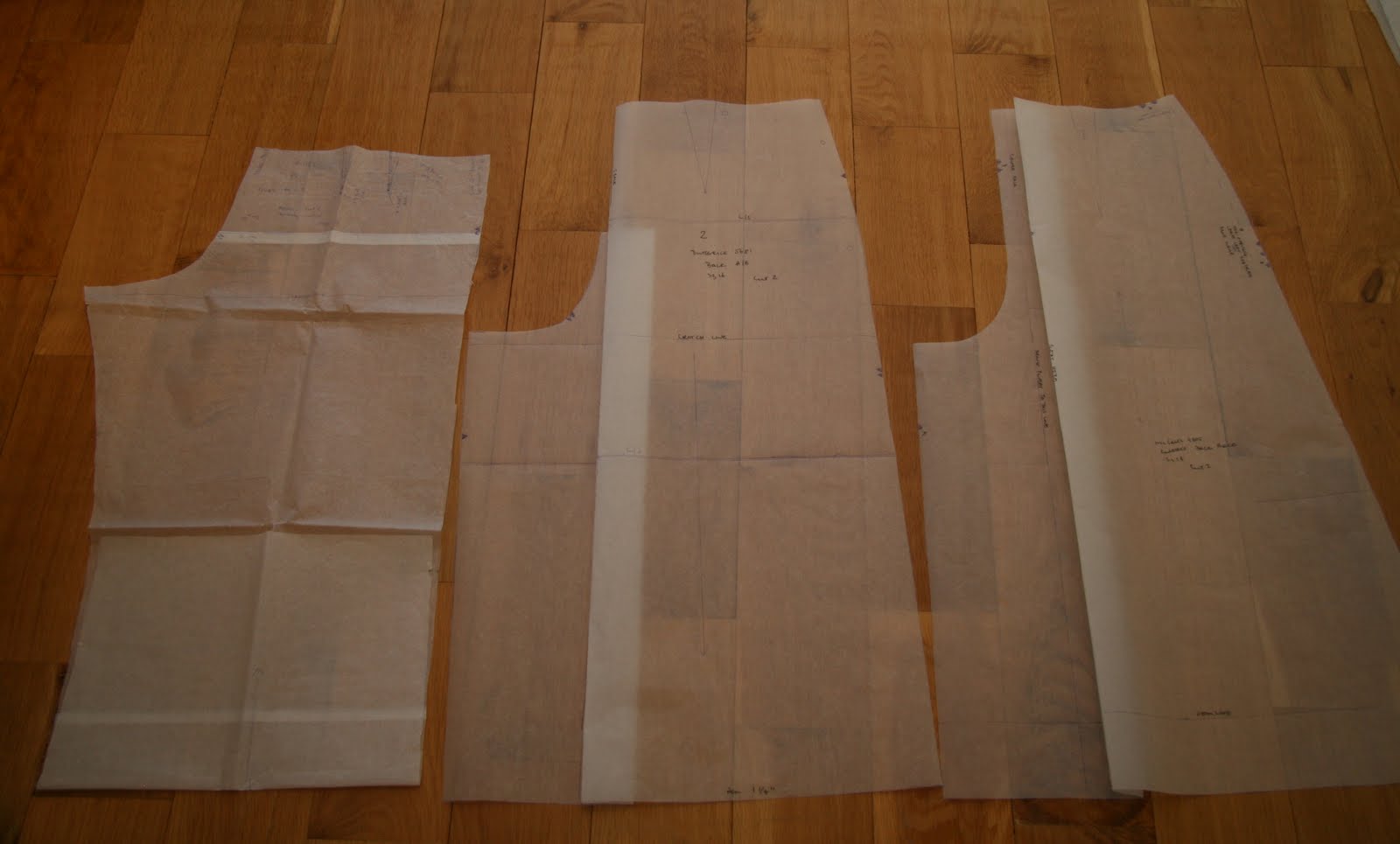
So, to get started, here are a few intro photos of side-by-side views of my now-traced TNT (V1166), M9805 and B5681. I urge you to notice on the "non-crotch" sides of the pattern pieces, specifically:

  • How utterly straight to the waist the TNT is. (Left piece)
  • How relatively curvy the vintage pattern is. (Right piece)
  • How the Butterick is more like the TNT. (Middle piece)
  • How much longer in the crotch both culottes pieces are in comparison with the mid-rise TNT pants pattern.
Back pieces, side-by-side

Front Pieces, side-by-side

Even accounting for my generally necessary, short crotch adjustment (about 1.25 inches on both front and back pieces - which you'll observe has already been done on the TNT), the culottes are way longer in the rise. I think that's partly cuz they're meant to be higher waisted than the pants. And I've read, in Pants for Real People, that culottes are meant to hang away from the body at the crotch by a much further distance than pants. How much farther, alas, they didn't say. We're merging the skirt with pants, peeps. Currently, it's a mystery.

First thing first, I removed some length in the crotch on both culottes pieces - approximately 1.25 inches. I don't know if it's the right course of action, but I have to start somewhere:

Back pieces, adjusted for crotch length

Front pieces, adjusted for crotch length

I think that's enough info for this post. My eyes are starting to cross...

Any thoughts about the experiment at this point? Please weigh in!

Saturday, January 28, 2012

Culottes, Then and Now

Let's go on an adventure, shall we?

In full disclosure, it's a sewing adventure, so you might already be bored. But I'm going to try to make it fascinating, like that subtype of documentary on PBS about physics (let's say) which, on the surface, is miserably dull but, despite yourself, by the end you are sad not to hear at least another hour's worth of info about the Law of Gravity. Note to reader: Once you get down to it, everything is somehow about the Law of Gravity. And is narrated by Martin Sheen.

OK, here's what I'm gonna do. Ya'll know about this pattern:


And you know this is the culottes pattern I have chosen to make as part of my Spring Basics Palette.

Wouldn't it be entrancing to see how they differ a) from each other - one vintage and one modern pattern and b) how the crotch curves of the original patterns differ from my own prior to alteration?

I know, you're drooling with anticipation.

But let me tell you a few other things before we get started on this path that's probably gonna take a few posts (and days of work, for that matter).

Sewist from way back, Lana, advised that:
  • Culottes date back to the 30's and were a kind of upgraded riding gear for women of that era.
  • Vintage versions tend to be made for those of extremely minimal derriere.
The new culottes (B5681) are a size 16 and the vintage ones (M9805) are an 18. These correlate with envelope sizing - waist 30" / hips 40" and waist 30" / hips 39". Standardized sizing has changed over the years, just to make things challenging.

I very gently opened the vintage pattern - still in factory folds - and carefully ironed it. You might as well tell me if this is a terrible crime to vintage. On the plus side, it made it possible for me to trace.

I also traced the modern pattern, though it was a total pain in the ass for something I could buy again tomorrow.

As yet untraced, boring, modern pattern...

Sassy, as yet untraced pocket of the vintage pattern.

How adorable that you get the WHOLE waistband when you sew vintage! (In truth, you get the whole waistband with the modern pattern too...)

More modern... Note that step action where the pleat meets the crotch. That doesn't happen in the vintage version (see below)...

More vintage... See how much more A line the vintage version appears to be? The modern one looks positively straight.


I love the way vintage patterns look. This one provides an ingenious double line to cut between in order to ensure you don't slice any of the seam allowance off when cutting into your fabric. This pattern also includes stitching lines in addition to cutting lines, so you can actually see the pattern sloper (aka block). Of course, modern patterns do not.

Intriguingly, the vintage pattern tissue was in very good shape, but the instructions (on construction paper) are definitely suffering the ravages of time. Weird since I don't think the pattern was ever used.

So, whatcha think? Are you game to compare vintage and modern garments? I'm going to muslin each of these (the top parts, any way) and which ever fits better will end up being the pattern I use to make my Spring Basics Palette culottes.

Time Traveling

I received my Blue Gardenia package of vintage patterns, which I bought recently during the 30% off sale. Wow.

Those of you who know me well, know that I am endlessly fascinated by things of other eras. I love shopping for vintage clothes because I believe the pieces are invested with the experience of another time. Don't get me wrong. I'm not particularly nostalgic. I don't think that time is better than this time. But it was and there's an energetic current between then and now and I love the idea that those two times can merge in modernity.

Let's face it: modernity is just another word for tomorrow's olden days.

As I was filtering through the 8 zillion pattern's on Denise's site, I narrowed my search to those with a 36 or 37 inch bust; they had half size patterns back then, for petites, which is how one finds sizing in the odd sized bust measurement.

In truth, I'm not much into the 30s and 40s patterns. I do find some of them spectacular - and time was, the best vintage clothing you could find (and it was plentiful in the shops) was from the 40s. But I always feel I'm playing to type in the 40s silhouette.

I kept it to the 50s, 60s and 70s, searching for wearable items. Nothing frothy and delicious, but with limited application. I intend to bring these garments to life on a regular basis.

So, let's get started on the tour, yes? Today we'll focus on the earliest patterns I purchased.

The Fifties:

McCall's 9805, from 1954, will assist me in my very firm intention to resuscitate the culotte. Not as silly as a skirt, not as intense as a pair of pants, culottes are the perfect solution for a day on the town! They look great with boots, in a winter fabric. Cute with a short heel sandal or ballerina flats in spring and summer. They have not gone out of fashion. They've just been sleeping in the recesses of our collective memory. Admit it: you want some!

Intriguingly, this pattern is from the first wave of those made with printed pieces (see The First Printed Pattern imprint). Before this, pieces were made with perforations to delineate instructions. As I am, frankly, afraid of those, this is my kind of 50's pattern.

It's starting to occur to me that I was so fixated on getting the right bust size, that I didn't pay any attention to the corollary waist and hip sizes. Fortunately in this pattern, the waist is 30" and the hips are 39". Alas, for the dress below, the waist is 28". Gonna have to work on that.

Butterick 8628, also from the 50s though the precise year is not identified, is another printed pattern, a whimsical "quick 'n easy" day dress. Oh, look, it's got a cowl neck. What a surprise! While "quick 'n easy" - it's not "light on fabric". This thing takes 6 yards of 35" width. (There's no mention of 60" width fabric on the envelope. Did it even exist, back then?) The dress has a waist stay, which seems very authentic.

The bodice is cut on the bias, the way many cowl neck bodices are. Intriguingly, the construction of this bodice is exactly the same as that on Vogue 8413, the dress I intend to make from the Spring Basics Palette.

Do you suppose one has to wear a crinoline (or some kind of voluminous slip) to get the skirt to fall that way?

What do you think of these? Which do you prefer? Do you have anything to add about the pedigree of these? Have you had the pleasure to sew with vintage?

Next up, the 60s!