The Challenges
I've spoken about the inherent challenges of working with vintage patterns before. I have been swatching for this sweater - not achieving gauge in stockinette stitch on a US size 1 needle. Mind you, I've just realized that the (exceedingly brief, as is the vintage way) instructions don't tell you to get gauge in stockinette. They don't say much of anything. But given that the entire sweater is in a crazy, complicated stitch pattern (more to come on this), seems to me I'd be wise to get gauge in that.
Intriguingly, and one of the things that's really thrown me off, the pattern recommends using a fingering-weight yarn (as far as I can tell from my research and the info culled from the instructions) with a US 6 needle (which, I believe, is the same today as it was in former days).
How could that possibly work, I thought initially, when I almost got gauge in stockinette on a size US 1 needle.
The other thing that's really been throwing me off - and swatching "in stitch" may have just addressed both of my challenges at once - is that the the pattern says I'll need @1900 yards of fingering yarn to make a size 16 (34" bust).
(Brief sidebar: Though my full bust measurement is 37.5, I've continuously discovered that less than 4 inches of negative ease yields a sweater that's too loose everywhere. This has been the case with vintage sweaters as well as with modern ones. Of course, I'm more careful when considering the sizing I'll require for vintage sweaters because they're known for being written with different standards and for different yarn at a time when bodies were less frequently shaped like mine.)
Most sweaters I make for myself, especially fitted ones, use a max of 1000 yards (often more like 900). You can see why I have concerns that I've researched incorrect info about the yarn the sweater was originally made in (Minerva Mellosheen cotton).
Briefly I considered that the, rather robust-looking, sweater was knit with two strands of yarn simultaneously. That doesn't appear to be the case.
So what gives?? How will I require so much yarn and such a large needle to make what's essentially a slim jacket with half-sleeves?
The (Potential) Epiphany
By swatching, in stitch-pattern, I think I may have figured it out - as I have also discovered that the very complicated stitch pattern yields an EXTREMELY firm and dense knit, which looks almost woven (but in a fancy diagonal way). Um, this isn't the project on which to aim for 5 inches of negative ease.
For starters, let me recite to you the stitch pattern (the whole darn sweater is knit in this BITCH of a pattern), which is unnamed but seems to be a lot like twisted knitting (as opposed to simple "knitting through the back loop" (TBL) or twisted rib).
RS: Skip first stitch, knit second stitch in back of work, then knit the first stitch (crossing the two stitches). Slip both stitches off. Repeat across row.
WS: P1, *skip 1 stitch, purl next stitch in front of work, then purl the skipped stitch (crossing the two stitches). Slip both stitches off*. Repeat from * across row, ending P1
Let me tell you how - after much thinking and trying various versions and watching what happened to the fabric etc., I interpret these instructions:
RS: Purl-wise slip 1 stitch to right needle. KTBL the second stitch. Keep the stitch on the left needle while simultaneously picking up the slipped stitch from the right needle and putting it back on the left needle to knit through it in the regular way. (This is how you cross the stitches.) Then remove both stitches from the left needle simultaneously.
WS: P1, purl-wise slip 1 stitch to the right needle, purl the next stitch and leave it on the left needle as you pick up the slipped stitch from the right needle and move it back onto the left needle. Carefully purl through the formerly-slipped "first stitch" without touching the originally-worked "next stitch" (This is how you cross the stitches). Then remove both stitches from the left needle simultaneously.
Important Note to Readers who aren't hardcore knitters: Don't bother trying to figure this out. If I showed you, in slow motion, what I have done to achieve this pattern, it would still overwhelm you with complexity. It's ABSURDLY complicated. The point is it a) requires a tremendous amount of dexterity and b) is a freakin' nightmare from the perspective of gaining stitches if one forgets to slip two off at the same time (after having worked them both). There's a LOT of room for error and no info on how to fix it. No doubt, I'm going to make mistakes and - as a baseline - I must be able to learn how I'm going to overcome those mistakes when I make them.
One plus, or is it a minus?: The fabric one knits is very forgiving given the complexity of the stitch pattern. Mistakes are difficult (if not impossible) to see and therefore that much more difficult to correct. Mind you, one shapes the fabric by increasing and decreasing stitches (I do wonder how that's accomplished on this kind of stitch pattern, because there aren't any clear instructions). Accidentally increasing them from parts unknown is not going to fly.
Other Brief Sidebar: I do not believe that knitters in 1950 were any more dexterous than the ones we have now. Knowing how to knit in garter or stockinette or rib or even cables or lacework doesn't require tremendous dexterity. Sure, some stitches are a bit more challenging in certain garments, but overall they're pretty doable once you figure them out and get into a groove.
The only other time I've ever encountered a stitch even approaching this level of finicky-ness is when I made a scarf wherein one purled into the same stitch 3 times over. That scarf ended up being half as long as it might have been; I got finger calluses, and I'll never bother with that again. BTW, that was vastly simpler than this.
Mind you, now I can see how this might take 1900 yards of yarn. It's called sweat-equity.
My next consideration is, do I go for it or do I decide that this is going to be a miserable lesson in my own limitations? I'm not ready to answer that yet. The practical, summer-slacker in me says give it a miss. The craft-adventurer says: what are you doing with yourself if you're not being challenged - and you'll be so impressive if you sort this out!
I'm going to spend the next few days swatching to get gauge.
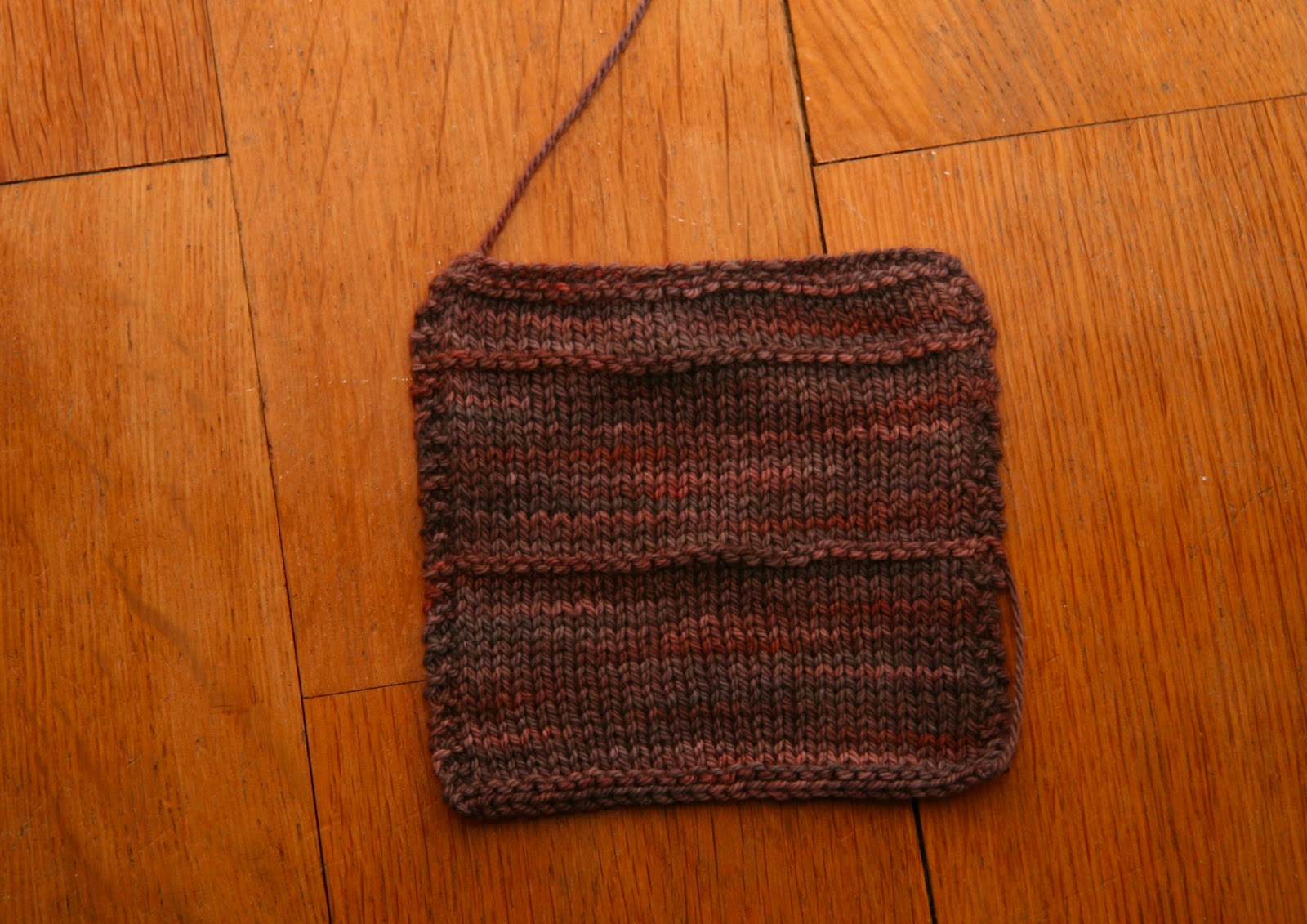
About my (made up) method of swatching to get gauge on tricky stitch patterns - those wherein it's almost impossible to distinguish one stitch from the next: Make a 4-inch wide x 4-inch high swatch using the number of stitches that the pattern tells will give you gauge at 4 x 4 (standard gauge area). This pattern proposes 8 stitches per inch and 7 rows per inch. So, to get 8 stitches and 7 rows per inch, I'm going to cast on 32 stitches (8x4) and aim to knit 28 rows (7x4). If, at the end I have a 4 x 4 swatch, I'll know I'm good to go. If it's off in one direction or another, I'll have to consider what's happening and go up or down a needle size or 2.
I should also mention that I haven't even started working on the "fitting math" for this thing (and Evie's starting to freak me out with all of her recent fit-knit stuff). I'm still trying to figure out whether I can manage the stitch! So that's, theoretically, 10 additional posts.
Time as Teacher:
Last night I was certain this was not to be. Today I've figured out a lot, and I'm not quite ready to give this project a miss on the basis of practicality.
One other thing I'll say about this today - I tried to find info about this stitch pattern on the web (the closest I could come was by searching for "twisted knit"). Apparently the stitch, or a variant of it, is usually done as a motif (aka not as a whole freakin' garment) AND since it's a bitch to purl (well, just as much of a bitch to purl as it is to knit), it's usually knit in the round. I have no intention of reworking this pattern in the round (it is a cardigan after all and steeking is not in the cards). If I wanted to look at a photo and draft my own pattern, I'd just pick something out of a magazine.
Today's questions - and they need your feedback!: If you know of this stitch pattern, and you can make something of my crazy ramblings, do you think I've interpreted it correctly? Have you ever worked this stitch pattern and, if so, do you think it's an exercise in insanity to make a sweater of it? Would you run screaming or give it a go? (Seriously - knitters of all natures, please do tell! I hate abandoning things almost as much as I hate failing. What should I do???)




 Posts
Posts


